Town Water Reports
Mulberry Water: What the EWG Report Shows
City of Mulberry water is groundwater for about 3,800 people. What EWG lists for it next to the legal limits, including thallium and DBCP, plus 2026 water rules.
Key takeaways
- City of Mulberry water is groundwater for about 3,800 people.
- EWG's Tap Water Database lists 16 contaminants detected, with 5 above EWG's own health guidelines.
- Every one of them that has a legal limit is below it, though TTHMs (64.8 ppb against 80) and thallium (1.25 ppb against 2) are closer than most.
- EWG's page notes the EPA's most recent quarterly review showed a health-based violation; the city's notices have the details.
The City of Mulberry pumps groundwater for about 3,800 people. This is a plain-English look at what the Environmental Working Group (EWG) lists for that water, how it compares with the legal limits, and what's been happening with it in 2026.
First, is this your water?
Homes outside city limits around Mulberry are often on Polk County Utilities or private wells. Check the name on your water bill. If it says City of Mulberry, this report is about your water.
What is the EWG Tap Water Database?
The Environmental Working Group (EWG) is a nonprofit that collects the testing results utilities report to the state and puts them in one searchable place. Next to each result it shows two numbers:
- The legal limit, set by the EPA. Utilities must stay under it.
- EWG's health guideline, a much stricter number EWG sets itself. It is not a legal limit.
Seeing both side by side is the honest way to read the report: it tells you what the law requires and how far some people would like to go beyond it.
What EWG lists for Mulberry city water
For the City of Mulberry, EWG lists 16 contaminants detected, and 5 are above EWG's guidelines. Here they are, with the legal limit for each:
| Contaminant | Level EWG lists | EWG guideline | Legal limit |
|---|---|---|---|
| Total trihalomethanes (TTHMs) | 64.8 ppb | 0.15 ppb | 80 ppb |
| Haloacetic acids (HAA5) | 21.7 ppb | 0.1 ppb | 60 ppb |
| Thallium | 1.25 ppb | 0.1 ppb | 2 ppb |
| 1,2-Dibromo-3-chloropropane (DBCP) | 0.00575 ppb | 0.0017 ppb | 0.2 ppb |
| Radium, combined (-226 and -228) | 1.71 pCi/L | 0.05 pCi/L | 5 pCi/L |
ppm = parts per million. ppb = parts per billion. ppt = parts per trillion. pCi/L = picocuries per liter, a unit for radioactivity. Source: EWG Tap Water Database, City of Mulberry.
How to read these numbers
Everything is under its legal limit. TTHMs are at 64.8 ppb against an 80 ppb limit, HAA5s at 21.7 ppb against 60, thallium at 1.25 ppb against 2, DBCP at 0.00575 ppb against 0.2, and radium at 1.71 pCi/L against 5.
Disinfection byproducts lead the list. TTHMs and haloacetic acids form when the disinfectant a utility adds to keep water germ-free reacts with natural organic matter. Our TTHMs and HAA5s guide explains them.
Two less familiar names. Thallium is a metal that can come from natural deposits or industry. DBCP is an old soil fumigant that was banned for most uses decades ago but can linger in groundwater.
EWG's page also notes a recent violation. EWG's page for Mulberry says the most recent quarter the EPA assessed showed a violation of federal health-based standards. It doesn't say which one. The city's annual water quality report and public notices are the place to see the details.
Which filter types EWG says can reduce them
EWG's database also shows which types of home filters can reduce each contaminant. For this system's list, it shows:
- Carbon filtration for most of this list, but not for thallium and radium.
- Reverse osmosis for everything on this list, including thallium and radium.
That's EWG's guidance about filter technologies in general. It is not a lab result for any particular system, and how much a filter reduces depends on its design and how it's maintained. Our pitcher vs. under-sink vs. whole-home guide walks through the trade-offs.
What's been happening with this water in 2026
Once-a-week watering. The Southwest Florida Water Management District's Modified Phase III water shortage order, effective April 3, 2026, limits lawn watering to one day a week across the district, including Polk County and homes on private wells. Check the city's current schedule before you water.
Boil-water notices. Small systems can lose pressure or disinfectant during power outages or repairs, and Mulberry has issued precautionary boil-water notices in the past. Our boil-water notice guide covers what to do if one reaches your street.
What this report can't tell you
A utility report is a system-wide picture, built from samples taken around the system over time. It doesn't measure what comes out of your kitchen faucet today. It also doesn't cover hardness, the thing most Mulberry homeowners actually notice on glasses, shower doors and fixtures. Our hard water guide covers that.
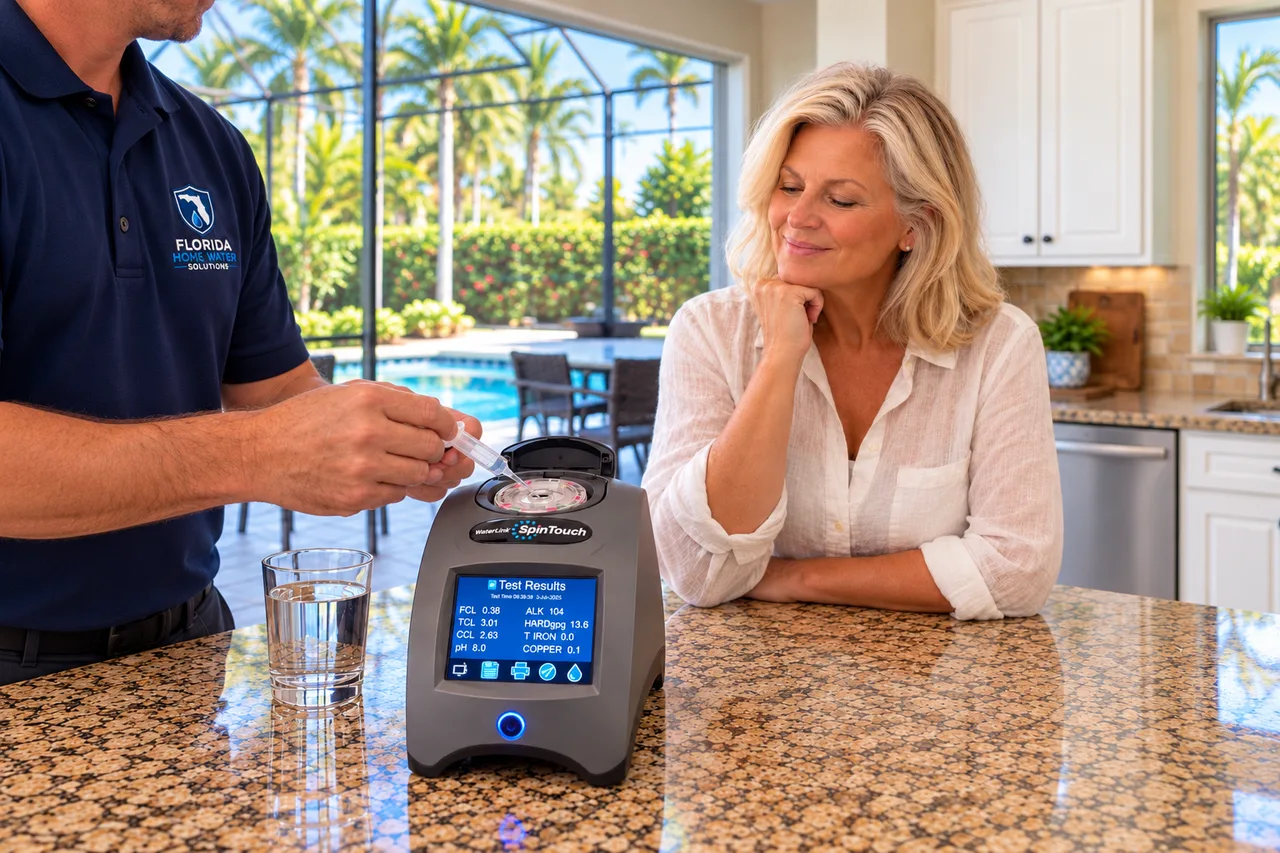
If you'd like to see your own numbers, we offer a free in-home water test of your raw tap water: chlorine and chloramine, hardness, pH and more, right at your kitchen counter. Call or text us anytime at (727) 334-0333.
Frequently asked questions
Is Mulberry water above the legal limits?
In EWG's Tap Water Database, every contaminant listed for Mulberry is below its legal limit. EWG also notes the EPA's most recent quarterly review showed a health-based violation, without naming it; the city's notices have the details.
What is thallium in Mulberry water?
Thallium is a metal that can come from natural deposits or industry. EWG lists Mulberry at 1.25 ppb; the legal limit is 2 ppb.
Sources
- Tap Water Database: utility report, Environmental Working Group
- Mulberry issues emergency boil water notice after chlorine levels drop following power outage, FOX 13
- Modified Phase III water shortage order fact sheet, Southwest Florida Water Management District
We check local facts against official sources such as utility water quality reports and government notices. Spot something out of date? Text us at (727) 334-0333 and we'll fix it.